3 Proven Tools to See Where Your Business Actually Ranks in Each Neighborhood
3 Proven Tools to See Where Your Business Actually Ranks in Each Neighborhood
1. Introduction: The Proximity Paradox
Imagine you own a high-end plumbing business. You sit in your office, pull out your smartphone, and search for “plumber near me.” There you are – Number 1 in the Google Map Pack. You feel confident. However, just three miles away, in a bustling residential neighborhood that represents 40% of your target market, a potential customer performs that exact same search. To them, you are invisible, buried on page three of the local results. This is the “Proximity Paradox.”
In the world of local search, rankings are not a “one size fits all” metric. Google’s local algorithm is heavily weighted by three primary pillars: Proximity, Relevance, and Prominence. While relevance (what you do) and prominence (how well-known you are) stay relatively stable, proximity is a moving target. Google’s goal is to provide the most convenient solution to the user, which means your rankings can fluctuate wildly based on every few hundred meters of movement.
Today, “near me” searches and local intent queries drive the vast majority of mobile traffic. If you aren’t tracking your visibility at a granular, neighborhood level, you aren’t seeing the real picture of your business health. You might be winning the battle at your front door but losing the war in the lucrative neighborhoods just down the road. To maintain a commanding presence, you must move beyond vanity metrics and embrace hyper-local data.
2. Why Traditional Rank Tracking Fails Local Businesses
For years, SEOs relied on “city-level” rank tracking. You would plug in a keyword like “personal injury lawyer” and a city like “Chicago,” and the tool would tell you that you are #4. But Chicago is 234 square miles. Being #4 in “Chicago” is a mathematical average that often hides the truth. Traditional tools simulate a search from a single data center or a static IP address, which fails to account for the “Blue Dot” accuracy of modern mobile devices.
Google’s algorithm uses the user’s precise GPS coordinates to determine the Map Pack. This creates a “centroid bias” where businesses closer to the user’s physical location are given an inherent advantage. If your tracking tool isn’t mimicking a user standing on a specific street corner in a specific neighborhood, the data is essentially useless for google business profile seo.
This is the real reason your competitors own the map pack while you stay hidden in certain areas. Without “Geo-Grid” technology, you are flying blind. Geo-grid tracking allows you to visualize your rankings across a map, showing exactly where your “ranking bubble” begins and ends. If you find that your visibility drops off sharply once you cross a major highway or enter a specific suburb, you have identified a geographic gap that requires targeted optimization. Understanding why your shop is stuck outside the top 3 map pack spots often starts with realizing that you only rank well in a tiny radius around your office.
3. Tool #1: Local Falcon, The Pioneer of Geo-Grids
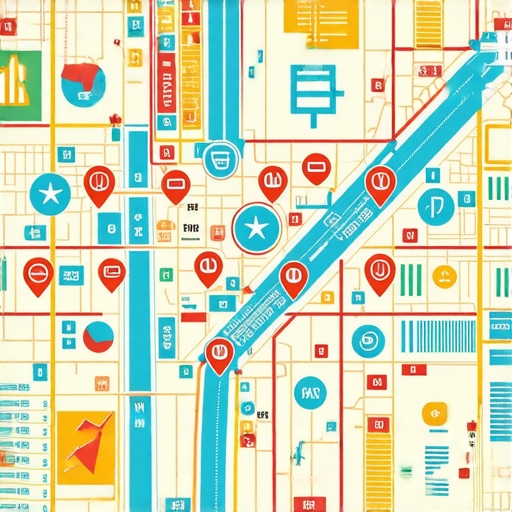
When it comes to visualizing local search dominance, Local Falcon is often cited as the pioneer of the geo-grid system. Instead of a list of numbers, Local Falcon provides a color-coded heatmap overlaid on a map of your city. Each “node” on the grid represents a specific GPS coordinate where a search was simulated.
The power of Local Falcon lies in its flexibility. You can set grid sizes ranging from a tight 3×3 (for hyper-local urban environments) to a massive 15×15 (for sprawling suburban service areas). This allows you to see exactly where your google business profile seo efforts are paying off. If you see green “1s” and “2s” near your location but red “10s” just a mile away, you know exactly where your boundary lies.
One of the most valuable metrics provided by this google maps rank tracker is the “Share of Local Voice” (SoLV). This metric calculates how often your business appears in the top three spots across the entire grid compared to your competitors. It’s an essential KPI for any serious local marketing strategy. By using scheduled scans, you can track how your rankings change over time, allowing you to see the immediate impact of new reviews, updated business descriptions, or localized backlink campaigns. Local Falcon helps you identify “ranking gaps” where a specific competitor might be over-performing, giving you a clear target for your next optimization sprint.
4. Tool #2: BrightLocal, The All-in-One Local Powerhouse
While Local Falcon is a specialized tool, BrightLocal offers a comprehensive suite designed for agencies and businesses that need more than just rank tracking. Their “Local Search Grid” tool is a formidable competitor in the geo-grid space, providing highly accurate, API-driven results that show your position in the local map pack for any given neighborhood.
What sets BrightLocal apart is how it integrates ranking data with other local SEO pillars. For example, it doesn’t just tell you that you rank #5 in a specific neighborhood; it also tracks your citation consistency (NAP: Name, Address, Phone Number) across the web. We know that citation accuracy is a key factor in building the trust Google needs to rank you further away from your physical location. You can use their tools to perform the 15-minute Google Maps audit that reveals why you’re invisible, identifying missing or incorrect listings that might be dragging down your prominence.
BrightLocal’s automated reporting is also a game-changer for those managing multiple locations. You can set up monthly reports that show “ranking momentum” – a clear visualization of whether your “green zone” is expanding or shrinking. To rank google business profile effectively, you need to see the correlation between your on-page SEO, your citation building, and your actual map performance. BrightLocal bridges these gaps, making it an essential piece of local seo software for those who want a holistic view of their digital footprint.
5. Tool #3: Whitespark, The Authority and Citation Specialist
Whitespark has long been a staple in the local SEO community, specifically known for its focus on the “Prominence” side of the Google algorithm. While they offer a robust local rank tracker, their “Local Citation Finder” is where they truly shine. In the philosophy of Michael Pilko, “Through proven SEO techniques, careful profile optimization, and precise citation building, your business can maintain a commanding presence in local search.” Whitespark is the tool that makes that “precise citation building” possible.
If your geo-grid data shows you are losing to a competitor in a specific high-value neighborhood, Whitespark allows you to reverse-engineer that competitor’s success. You can find exactly where they are mentioned online – local directories, neighborhood blogs, or chamber of commerce sites – that you are not. By closing this “citation gap,” you increase your business’s prominence, which signals to Google that you are a relevant result even for users who aren’t standing right next to your building.
Using Whitespark as your primary local seo software ensures that you aren’t just tracking the symptoms (rankings) but are actually treating the cause (authority). Their rank tracker also handles both organic and map pack results, giving you a dual view of how your website and your Google Business Profile are working together. When you combine neighborhood-level tracking with aggressive citation acquisition, you create a moat around your business that competitors find difficult to cross. This is a core component of how to improve map rankings with effective optimization techniques.
6. Strategy: How to Turn Neighborhood Data into Rankings
Tracking is only the first step. The real magic happens when you turn that data into an actionable google business profile seo strategy. Once you have identified the neighborhoods where your rankings are weak, you can begin a targeted “expansion” campaign.
- Identify Weak Neighborhoods: Use your geo-grid tool to find “red zones” that have high commercial intent but low visibility for your business.
- Create Hyperlocal Content: If you want to rank in “Lincoln Park,” your website and GBP updates should mention Lincoln Park. Talk about local landmarks, sponsor a neighborhood little league team, or write a blog post about common issues homeowners face in that specific area.
- Geo-Tagged Media: Upload photos to your Google Business Profile that were actually taken in those target neighborhoods. Google reads the metadata and GPS tags of images, which can help associate your profile with those specific coordinates.
- Localized Backlinks: Reach out to neighborhood-specific blogs or organizations for mentions. A link from a “West End Community Association” carries significant weight for searches happening in the West End.
By focusing on these 5 map pack ranking factors that actually move the needle for local traffic, you can slowly push your “green zone” further into competitor territory. It is a game of inches, but with the right data, you can win it.
7. Conclusion & Final Recommendation
In the modern local search landscape, “ranking in the city” is a myth. You rank in neighborhoods, on street corners, and in shopping centers. To dominate your market, you must use local seo tools that provide the granularity required to see the truth. Whether you choose the visual heatmaps of Local Falcon, the comprehensive suite of BrightLocal, or the citation-heavy approach of Whitespark, the goal remains the same: total local visibility.
Stop guessing where your customers are finding you. Audit your profile today, identify your ranking boundaries, and use a strategic approach to rank google business profile across every neighborhood you serve. The data is available – it’s time to use it.